
The Ultimate Guide to Material Compatibility: Ensuring Safety and Stability in Cosmetic Tubes

In the high-stakes world of beauty and personal care manufacturing, the relationship between a product’s formula and its packaging is more than just functional—it is chemical. For procurement managers and R&D specialists at cosmetic factories, selecting a cosmetic tube is not merely an aesthetic choice; it is a technical decision that determines the shelf life, efficacy, and safety of the final product.
Whether you are launching a high-potency Vitamin C facial cleanser, a mineral-based sunscreen, or a urea-rich hand cream, the risk of “leachables,” “extractables,” and “permeation” is ever-present. If the packaging material reacts with the active ingredients, the results can be disastrous: tube delamination, formula discoloration, or even chemical instability that renders the product unsafe for consumers.
In this guide, we dive deep into the science of material compatibility, comparing PE, ABL, and PBL structures to help you make informed sourcing decisions for your brand, Xinfly Packaging.
Before sourcing wholesale cosmetic tubes, it is vital to understand the four primary ways a formula interacts with its container:
- Permeation & Weight Loss: Volatile oils and water can migrate through the tube wall and evaporate, leading to product shrinkage and altered concentrations.
- Absorption (The “Scalping” Effect): Plastic materials (like LDPE) can absorb fragrances and essential oils, resulting in a loss of scent or reduced preservative efficacy.
- Environmental Stress Cracking (ESC): Certain surfactants in facial cleansers can weaken polymer chains, causing microscopic cracks and eventual leakage.
- Leaching: Chemicals from the packaging (like plasticizers) can migrate into the formula—a major concern for Clean Beauty brands seeking FDA/REACH compliance.
Key Takeaways
- Cosmetic tubes play a crucial role in maintaining the efficacy and safety of beauty products by ensuring material compatibility.
- Understanding interactions like permeation, absorption, chemical reactions, and leaching helps in selecting the right packaging.
- Different tube structures such as PE, ABL, and PBL offer various benefits and barriers for specific product needs.
- Stability testing is essential for verifying that cosmetic tubes protect products from damage over time.
- Sustainability and safety must coexist, which can be achieved with eco-friendly materials like PCR without sacrificing quality.
The Science of Interaction: Why Compatibility Fails
Before selecting a wholesale cosmetic tube, it is vital to understand the four primary ways a formula interacts with its container.
A. Permeation and Weight Loss
Many cosmetic formulas, especially those for hand creams and lotions, contain high percentages of water and volatile oils. If the plastic tube wall has a low barrier property, these molecules can migrate through the plastic and evaporate into the air. This leads to “weight loss,” where the product shrinks inside the tube, potentially changing the concentration of active ingredients and altering the texture.
B. Absorption (The “Scalping” Effect)
Plastic materials, particularly LDPE, can act like a sponge for certain organic molecules. Fragrances, essential oils, and preservatives can be “scalped” or absorbed into the tube wall. This results in a loss of scent or, more dangerously, a reduction in preservative efficacy, leading to microbial growth.
C. Chemical Reaction and Stress Cracking
Certain surfactants used in facial cleansers can cause “environmental stress cracking” (ESC) in polyethylene. Under the pressure of repeated squeezing, the polymer chains weaken and microscopic cracks appear, eventually leading to leakage.
D. Leaching
Inversely, chemicals from the cosmetic packaging—such as plasticizers or slip agents—can leach into the formula. This is a major concern for “Clean Beauty” brands that must adhere to strict FDA compliance or REACH regulations in Europe.Xinfly Packaging has ISO Certificate, RoHS (RoHS No.: NTS2405005R), SGS (Test Report No.: GZHL24050181970T. You can check online at https://www.sgsonline.com.cn/DocCheck ), PCR Cosmetic tube GRS Certificate (GRS-Certificate No.: ITS-TE-00059997-GRS-G) and third-party testing.You can find more Certifications at https://cosmetic-tubes.com/certifications/
Deciphering Tube Structures: PE vs. ABL vs. PBL
To mitigate these risks, a professional packaging supplier must offer a variety of material structures. Each has a specific “barrier profile” suited for different product types.
| Material Structure | Best For | Technical Advantage |
| Mono-PE / 2-Layer PE | Hand Creams & Lotions | Highly flexible and cost-effective. |
| 5-Layer COEX (EVOH) | Whitening Serums & SPF | Ultra-thin oxygen barrier to prevent oxidation. |
| ABL (Aluminum Laminate) | Pharmaceuticals & Sunscreen | 100% barrier against light and moisture; “dead-fold” property. |
| PBL (Plastic Laminate) | High-End Cleansers | High-definition aesthetics + excellent chemical resistance. |
PE Cosmetic Tubes (Monolayer or Multi-layer)
Polyethylene (PE) is the industry standard for basic skincare.
- Best for: Standard moisturizing lotions, basic hair conditioners, and rinse-off products.
- Pros: Highly flexible, excellent “soft touch” feel, and 100% recyclable.
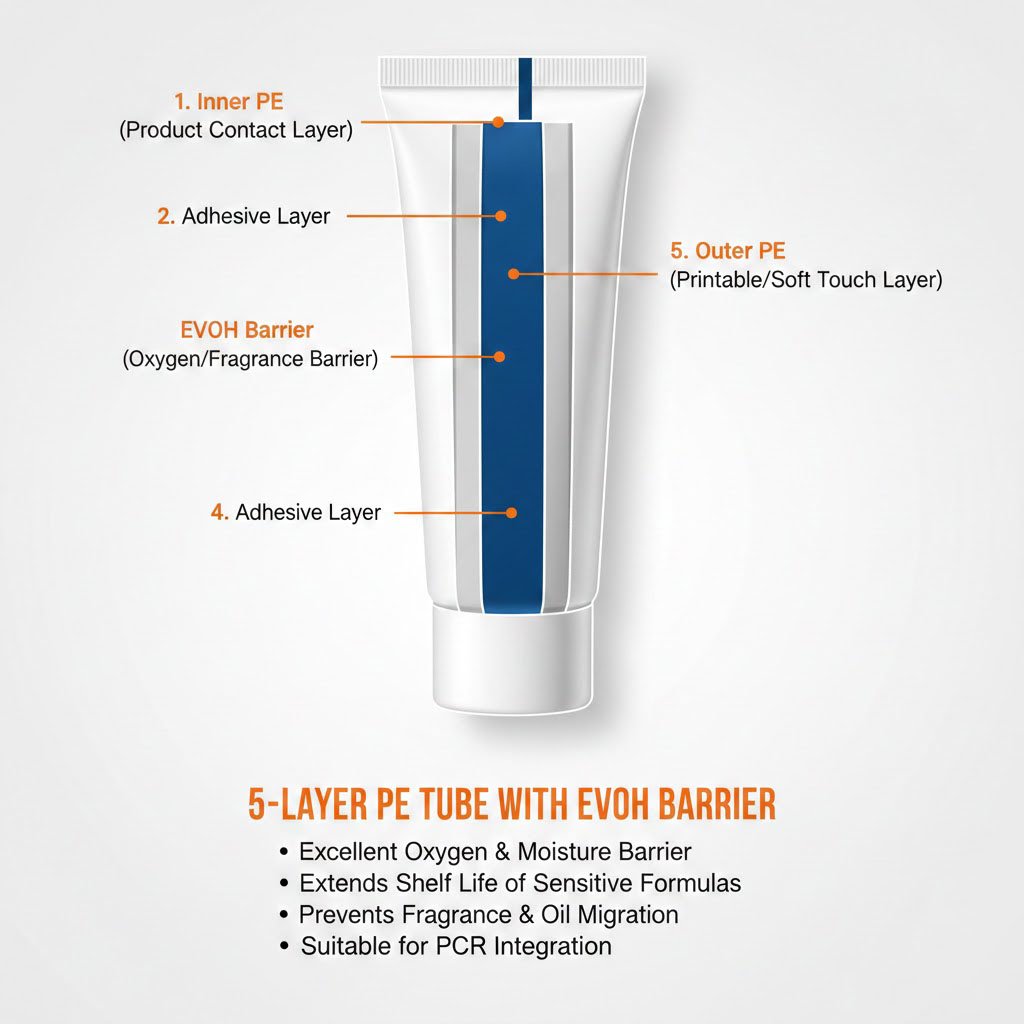
- Compatibility Note: Monolayer PE has poor barrier properties against oxygen and essential oils. For formulas with active ingredients, a 5-layer PE tube with an EVOH (Ethylene Vinyl Alcohol) barrier layer is essential to prevent oxygen from degrading the formula.
ABL (Aluminum Barrier Laminate)
ABL tubes feature a thin layer of aluminum foil sandwiched between plastic layers.
- Best for: Pharmaceutical creams, sunscreen packaging, and high-potency anti-aging serums.
- Pros: Provides a near-total barrier against light, oxygen, and moisture. It has “dead-fold” characteristics (it stays squeezed).
- Compatibility Note: ABL is the gold standard for stability. However, the formula must be tested to ensure it doesn’t cause “delamination,” where the chemical breaks the bond between the aluminum and the plastic.
PBL (Plastic Barrier Laminate)
PBL utilizes a plastic barrier (usually EVOH) instead of aluminum.
- Best for: High-end facial cleansers and color cosmetics.
- Pros: Superior aesthetics (the tube bounces back to its original shape) and supports high-definition digital printing.
- Compatibility Note: While slightly less effective than ABL for oxygen-sensitive products, PBL offers excellent chemical resistance and is often preferred for “prestige” branding.
Targeted Solutions for Specific Cosmetic Categories
As a cosmetic tube manufacturer, we see specific challenges across different product lines. Here is how to match the material to the formula:
High-SPF Sunscreens
Sunscreen tubes face two challenges: UV exposure and high oil content. Chemical UV filters can sometimes “soften” the plastic. We recommend ABL tubes or PCR (Post-Consumer Recycled) plastics with a high-density barrier to ensure the SPF rating remains stable for 24+ months.
Intensive Hand Creams
Hand creams often contain high concentrations of urea, glycerin, or botanical oils. To prevent the oils from seeping into the packaging material and making the tube feel greasy or “sticky” on the outside, a multi-layer co-extruded tube is necessary.
Facial Cleansers with Actives
Cleansers containing Salicylic Acid or Glycolic Acid require a chemically resistant inner liner. PBL cosmetic tubes are often the best choice here, providing a clean look while resisting the acidic nature of the formula.
The Procurement Checklist: Stability Testing Protocol
A professional sourcing manager should never approve a mass production run without rigorous stability testing. When partnering with Xinfly Packaging, we encourage the following protocols:
- High-Temperature Aging: Place the filled cosmetic tube in an oven at 45°C or 50°C for 30 to 90 days. This simulates one to two years of shelf life at room temperature. Check for changes in pH, color, and tube integrity.
- Vacuum Leakage Test: Vital for flip-top caps and screw caps. Ensure that under pressure, the formula does not bypass the seal.
- Compatibility Analysis: Check for “swelling” of the tube wall. If the tube diameter increases or the plastic becomes soft, the formula is reacting with the polymer.
- Light Transmission Test: For formulas containing Retinol or Vitamin C, ensure the tube wall is opaque enough to prevent photo-degradation.
Stability Testing Protocol: The Xinfly Standard
A professional procurement officer should never approve mass production without rigorous stability data. We recommend the following protocols:
- Accelerated Aging Test: Store filled tubes at 45°C or 50°C for 30–90 days to simulate 12–24 months of shelf life.
- Vacuum Leakage Test: Vital for flip-top and screw caps to ensure the seal holds under international shipping pressures.
- Weight Loss Analysis: Monitoring the tube over time to ensure the net weight remains within a 1%–2% tolerance.
- Light Transmission Test: Critical for Retinol or Vitamin C to ensure the tube wall is opaque enough to prevent photo-degradation.
Sustainability Without Compromise
At Xinfly Packaging, we prove that “Green” can be “Stable.”
- PCR (Post-Consumer Recycled) Tubes: We utilize a 5-layer structure where the formula only touches a virgin PE inner layer, ensuring 100% safety even with a recycled outer shell.
- Sugarcane Bio-PE: Chemically identical to virgin plastic, offering the same compatibility while reducing the carbon footprint.
Sustainability Meets Safety: The Role of PCR and Eco-Materials
The modern procurement officer is under pressure to move toward “Green Packaging.” However, sustainability cannot come at the cost of safety.
At Xinfly Packaging, we offer PCR cosmetic tubes and Sugarcane-based PE. These materials are chemically identical to virgin plastic, meaning they offer the same material compatibility while reducing the carbon footprint. When switching to eco-friendly options, we recommend a secondary stability test to ensure that the recycled content does not affect the odor or color of your premium skincare products.
Partnering for Product Integrity
In the competitive landscape of cosmetic manufacturing, the packaging is the guardian of your brand’s reputation. A leak, a discolored cream, or a failed preservative system can lead to costly recalls and lost consumer trust.
By understanding the technical nuances of PE, ABL, and PBL materials, and insisting on rigorous compatibility testing, you ensure that your hand cream, sunscreen, or facial cleanser reaches the consumer exactly as the chemist intended.
At Jiangsu Xinfly Packaging Co., Ltd, we pride ourselves on being more than a supplier—we are your technical partner. Our expertise in cosmetic tube manufacturing and global standards ensures that your packaging is as safe as it is beautiful.
Jeff Shao | General Manager & Founder
Jiangsu Xinfly Packaging Co., Ltd.
Professional Cosmetic Tube Manufacturer
| Email: | Sales@cosmetic-tubes.com |
| Mobile: | +86-18952591688 (WhatsApp) |
| Tel: | +86-514-85586800 |
| Web: | www.cosmetic-tubes.com |
| Add: | No. 68, Yingchun Road, Guangling Industrial Park, Yangzhou City, China. |
P: Normally we will reply all your inquiries/replies within 24 hours!
Quick Guide: Material Selection vs. Formula
| Formula Type | Recommended Material | Reasoning |
|---|---|---|
| Body Lotion / Hand Cream | Mono-PE / 2-Layer PE | Cost-effective, good flexibility. |
| Vitamin C / Whitening Serums | 5-Layer EVOH / ABL | High oxygen barrier to prevent oxidation. |
| Sunscreen / SPF Products | 5-Layer EVOH / ABL | Prevents active ingredient separation. |
| Essential Oil / Fragrance | ABL / High-Barrier PBL | Prevents oil migration through plastic. |
Technical Support & FAQs
Need Technical Advice for Your Formula?
Ensure your formula remains safe and stable with the right material choice. Consult with our technical team today.
GET TECHNICAL SUPPORT